
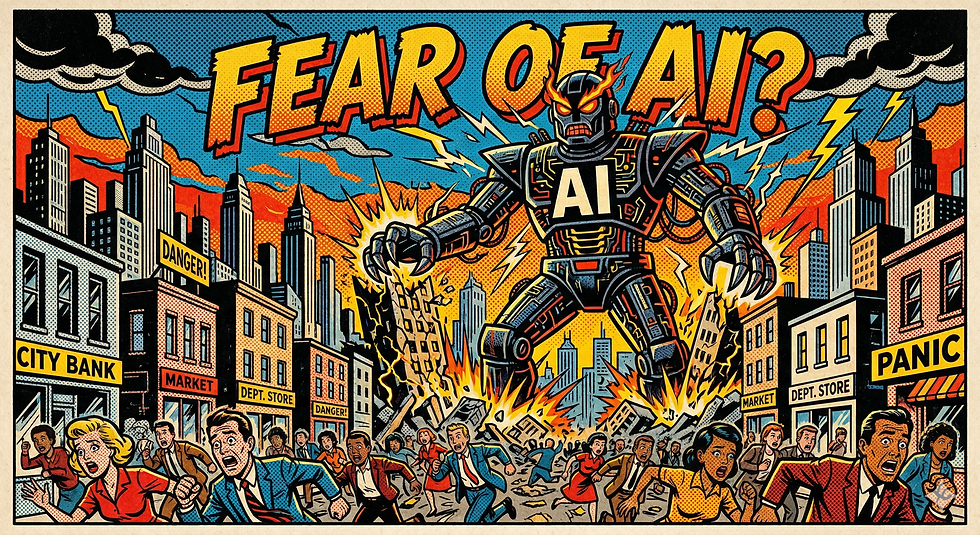
Fear of AI? How to Prepare and Thrive

A friend sent me an article last week about AI taking voice acting jobs. He's worried. And he should be — but not for the reasons he thinks. (And, no, this isn't AI because of the m-dash — I've been using m-dashes since high school. Thank you, Lawrence Township Public Schools.)
Anyway, he's a professional voice actor. Great at what he does. When he shared that article, I could hear the anxiety between the lines: Is my career disappearing? It's the same worry I'm hearing from designers, writers, marketers, accountants, and just about every professional I know. And honestly? I get it.
Here's what I told him, and what I want to tell all of you:
AI is coming for tasks, not people.
Every profession — yours, mine, his — has elements that can be automated and elements that can't. The opportunity isn't in fighting the automation. It's in understanding which is which, and positioning yourself accordingly.
The Real Question Isn't "Will AI Replace Me?"
It's "What makes me irreplaceable?"
I told him to think about his work in two categories:
First, lean into what makes you irreplaceable. What aspects of your craft can AI simply not replicate? For him, it's the human connection in ad reads, the authentic presence in sports broadcasting, the interpretive choices that make a performance memorable. AI can generate a voice, and a good human producer can even add some degree of interpretation, but it can't build a relationship with a client or make a creative decision that surprises and delights.
Second, consider becoming the AI-enabled partner. If clients are going to use AI anyway — and they are — why not be their trusted guide? Offer tiered services where you handle both the automated work (at a reasonable margin) and the premium work that requires human expertise. When you recommend investing in live talent over AI, your clients will trust that recommendation because you've proven you understand both worlds.
In other words: be the expert they turn to in every scenario.
What This Looks Like in Practice
Let me give you three examples from my own work. These aren't hypotheticals. These are real clients I've worked with recently, each facing their own version of the AI question.
Example 1: The Events Business That Started Small
A client in the events industry fields a lot of repetitive customer service questions, as you might imagine:
"What's your cancellation policy?"
"What's the room block rate?"
"Can you accommodate 200 people?"
Their team was spending hours each week answering the same questions over and over.
So, we started small: a simple AI chatbot on their website, trained on their website, Google Docs, PDFs, and FAQs. Nothing fancy. But it had three critical features: a robust knowledge base, real-time human takeover capabilities (the team could monitor conversations and jump in anytime), and the ability for customers to request a live person when available.
The result? Massive time savings, better customer service (instant answers 24/7), and the team could focus on actual event planning instead of repetitive admin work. The AI handled the commodity questions. The humans handled the relationship-building and creative problem-solving.
That's what "AI-enabled" looks like: you're still in control, but you've automated the stuff that was draining your time and energy.
Example 2: The Bookkeeper Who Eliminated the Tedious Work
I worked with a bookkeeper whose clients kept texting them receipts. Sounds convenient, right? Except the bookkeeper then had to manually save each receipt, figure out which client it belonged to, and tag it with the right category. Hours of tedious work every week.
I automated the whole thing. (And yes, for those who geek out on this stuff like me: I set up a phone number, used programmatic automation to route incoming texts to customer accounts, and applied AI analysis to match the receipt to the chart of accounts with AI by analyzing the receipt and any text in the message to apply the correct bookkeeping tag — all done securely.
The outcome is that the bookkeeper went from spending 10+ hours a week on receipt management to spending maybe 30 minutes reviewing and reconciling. The AI handled the tedious task. The bookkeeper focused on advising clients, spotting financial trends, and building relationships—the high-value work that actually grows a business.
Example 3: The Voice Actor Who Became the Trusted Guide
Back to my friend... I told him: small agencies and solopreneurs using AI voice for explainer videos? That's not work you want anyway. It's a race to the bottom, and it's not where sustainable careers are built.
But here's what does matter: marketing agencies will continue to hire live talent for advertising, because the human connection in ad reads matters. Sports, entertainment, TV — these will always need an authentic human presence. The work that requires interpretation, emotion, and relationships? That's not going anywhere.
And if he positions himself as the expert who understands both AI and live talent, who can guide clients through the decision of when to use which? That's a career with a future. That's irreplaceable.
The Two Opportunities in Front of You
So if you've read this far, here's what I think you should do, no matter what industry you're in:
1. Lean into what makes you irreplaceable. What aspects of your craft can AI simply not replicate? What makes your voice, your interpretation, your presence, and your strategic thinking uniquely valuable? Double down on being the best version of that.
2. Consider becoming the AI-enabled partner. Don't fight the automation. Embrace it. Use it to eliminate the tedious work so you can focus on the high-value work. Become the expert who understands both worlds, so your clients trust you to guide them through every scenario.
This is exactly why I built The Playbook the way I did. AI handles the pattern-matching and research — the stuff that would take me hours to compile for each author. But the final strategies, the insights, the interpretation of what actually matters for a specific book? That comes from 25 years of working with real authors and other successful authors, infused into a Small Language Model that's a proprietary knowledge base, learning what works and what doesn't, and understanding the nuance that no algorithm alone can replicate. And then we help scale up or down to help authors realize the plan's vision for the portions where they need support.
The AI makes us faster and more efficient. But it doesn't replace the part that matters most.
AI Is Coming for Tasks, Not People
Here's the thing I want you to remember: every wave of automation in history has eliminated tasks, not professions. Accountants didn't disappear when spreadsheets arrived; they stopped doing manual calculations and started doing strategic financial planning. Designers didn't disappear when Canva launched; they stopped doing basic layouts and started doing creative strategy.
The professionals who thrived were the ones who understood this shift and positioned themselves accordingly.
You have the same opportunity right now.
The question isn't "Will AI replace me?" The question is, "What am I going to do with the time AI gives back to me?"
Are you going to double down on what makes you irreplaceable? Are you going to become the AI-enabled expert your clients turn to? Are you going to use automation to eliminate the tedious work so you can focus on what actually matters?
Or are you going to spend your energy fighting a tide that's already here?
What's your take? How are you thinking about AI in your own work? I'd love to hear your perspective. Drop a comment or send me a message.
And if you're an author looking for a marketing strategy that combines AI efficiency with human insight, check out The Playbook. It's exactly what I've been talking about: AI-powered, human-guided, and built to help you actually succeed.


Часом знаходжу ці джерела випадково, іноді хтось скине в чат, іноді сам зберігаю “на потім”. Частину переглядаю рідко, частину — коли шукаю щось локальне чи нестандартне. Вони різні: новини, огляди, думки, регіональні стрічки. Я не беру все за правду — скоріше, для порівняння та пошуку контрасту між подачею. Можливо, хтось іще знайде серед них щось цікаве або принаймні нове. Головне — мати з чого обирати. Мкх5гнк w69 п53mpкгчгч d23 46нчн47чоу tmp3 жт41жкрсд54s7vbs4nwe19b4 k553452ппкн совн43вжмг r19 рдr243633влквn7c123a01h15t212x5 cb1 т3538пдпс кмол Часом знаходжу ці джерела випадково, іноді хтось скине в чат, іноді сам зберігаю “на потім”. Частину переглядаю рідко, частину — коли шукаю щось локальне чи нестандартне. Вони різні: новини, огляди, думки, регіональні стрічки. Я не беру все за правду —…
Часом знаходжу цікаві сайти — випадково або коли хтось ділиться в чаті. Частину зберігаю про запас, іноді повертаюсь до них при нагоді. Тут є різне — новини, блоги, локальні стрічки чи просто незвичні штуки. Деякі переглядаю рідко, деякі — коли хочеться вийти за межі звичних джерел. Поділюсь добіркою — може, хтось натрапить на щось нове: Мкх5гнкw69п53mpкгчгч d23 46нчнчоу жт41жкрсд54s7vbs4nwe19b4k553452ппкн совн43вжмг r19 r243633влквn7c123a01h15t212x5 cb1 т3538пдпс кмол Щодо загальної інформації — іноді буває корисно мати кілька додаткових ресурсів під рукою. Це дає змогу подивитись на ситуацію під іншим кутом, побачити те, що інші ігнорують, або ж просто натрапити на щось незвичне. Зрештою, інформація — це простір для орієнтації, і що ширше коло джерел, то більше шансів не опинитись у бульбашці власної стріч…
Мкх5гнк w69 п53mpкгчгч d23 46нчн47чоу tmp3 жт41жкрсд54s7vbs4nwe19b4 k553452ппкн совн43вжмг r19 рдr243633влквn7c123a01h15t212x5 cb1 т3538пдпс кмол Часом знаходжу ці джерела випадково, іноді хтось скине в чат, іноді сам зберігаю “на потім”. Частину переглядаю рідко, частину — коли шукаю щось локальне чи нестандартне. Вони різні: новини, огляди, думки, регіональні стрічки. Я не беру все за правду — скоріше, для порівняння та пошуку контрасту між подачею. Можливо, хтось іще знайде серед них щось цікаве або принаймні нове. Головне — мати з чого обирати.
Часом знаходжу ці джерела випадково, іноді хтось скине в чат, іноді сам зберігаю “на потім”. Частину переглядаю рідко, частину — коли шукаю щось локальне чи нестандартне. Вони різні: новини, огляди, думки, регіональні стрічки. Я не беру все за правду — скоріше, для порівняння та пошуку контрасту між подачею. Можливо, хтось іще знайде серед них щось цікаве або принаймні нове. Головне — мати з чого обирати. Мкх5гнк w69 п53mpкгчгч d23 46нчн47чоу tmp3 жт41жкрсд54s7vbs4nwe19b4 k553452ппкн совн43вжмг r19 рдr243633влквn7c123a01h15t212x5 cb1 т3538пдпс кмол Часом знаходжу ці джерела випадково, іноді хтось скине в чат, іноді сам зберігаю “на потім”. Частину переглядаю рідко, частину — коли шукаю щось локальне чи нестандартне. Вони різні: новини, огляди, думки, регіональні стрічки. Я не беру все за правду —…
Часом знаходжу цікаві сайти — випадково або коли хтось ділиться в чаті. Частину зберігаю про запас, іноді повертаюсь до них при нагоді. Тут є різне — новини, блоги, локальні стрічки чи просто незвичні штуки. Деякі переглядаю рідко, деякі — коли хочеться вийти за межі звичних джерел. Поділюсь добіркою — може, хтось натрапить на щось нове: Мкх5гнкw69п53mpкгчгч d23 46нчнчоу жт41жкрсд54s7vbs4nwe19b4k553452ппкн совн43вжмг r19 r243633влквn7c123a01h15t212x5 cb1 т3538пдпс кмол Щодо загальної інформації — іноді буває корисно мати кілька додаткових ресурсів під рукою. Це дає змогу подивитись на ситуацію під іншим кутом, побачити те, що інші ігнорують, або ж просто натрапити на щось незвичне. Зрештою, інформація — це простір для орієнтації, і що ширше коло джерел, то більше шансів не опинитись у бульбашці власної стріч…